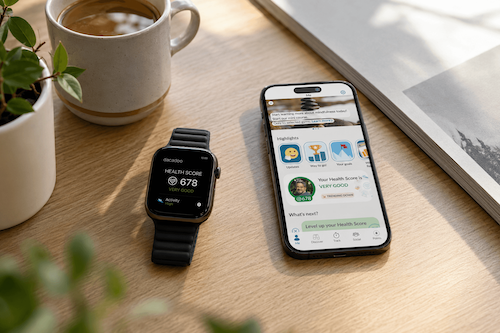












Retailers are investing heavily in wellness and health features inside loyalty apps, however, in many cases, shoppers aren’t using them as frequently or consistently as expected. It’s not that consumers aren’t interested in their well-being—data from NIQ‘s Global State of Health & Wellness and Deloitte‘s Consumer Loyalty Survey suggests consumers are more health-conscious than ever. The challenge lies in the positioning, relevance, and user experience associated with these features.
When wellness tools feel like a bolt-on rather than a core part of the shopping journey, retail loyalty app engagement suffers. In this article, we’ll examine how retailers can drive customer loyalty by offering value-driven experiences and how technology like dacadoo’s Digital Health Engagement Platform (DHEP) can help.
Key Takeaways
Relevance is everything: Shoppers ignore health features when they are buried, generic, or disconnected from immediate shopping goals.
The value gap: Loyalty engagement depends on a clear value exchange—visibility, personalization, and tangible rewards.
Integration over Isolation: Wellness tools perform best when they support everyday actions like meal planning, healthier basket choices, and family well-being.
Intrinsic functionality: Retailers can drive loyalty app feature adoption by embedding health into existing journeys instead of treating it as a secondary tab.
Why do users ignore health features in loyalty apps?
Users ignore health features for 4 main reasons:
Low Relevance: The feature doesn’t match the shopper’s intent.
Poor Visibility: Shoppers don’t notice features that are buried deep within an app.
Weak Incentives: There’s no compelling reason to return.
No Clear Everyday Value: The health advice offered feels too abstract for a retail environment.
Importantly, these challenges are not a limitation of health engagement itself—they reflect how many features are currently implemented, often outside the context of real shopping behavior.
So, let’s take a look at each of these reasons and what they actually mean for retail loyalty schemes and apps.
Reason 1: Low Relevance – The Feature Does Not Match Shopper Intent
When users open a grocery loyalty app or a pharmacy loyalty app, they tend to do so for specific purposes such as shopping, refilling a prescription, or finding a discount. If a health feature feels detached from these purposes, it’s viewed as little more than background noise.
With current research from EY’s Loyalty Market Study and Deloitte’s Consumer Loyalty Survey emphasizing that personalization is now a baseline customer expectation, retail app engagement will also suffer if the wellness component is a generic one-size-fits-all module.
The failure of wellness feature adoption is most evident when tools feel siloed from the transaction. When a shopper is looking for a specific infant formula deal, there’s little impact if a generic pop-up about “staying hydrated” appears. It’s much the same story when a user is tracking steps through a grocery loyalty app that offers no points or rewards for their activity.
When static health content remains disconnected from a shopper’s specific products, health goals, or household needs, it becomes difficult for the user to see its immediate value.
Reason 2: Poor Visibility – Shoppers Don’t Notice What Is Buried

If a feature isn’t seen, it effectively doesn’t exist. Baymard’s mobile app research shows that many retail apps underperform on basic usability. When health features in loyalty apps are tucked away in a sub-menu labeled “More,” discoverability drops significantly.
Many pharmacy loyalty apps, for example, bury their most valuable health tools inside secondary navigation tabs, forcing users to hunt for utility. This hide-and-seek UX is compounded when apps fail to offer prompts at key decision moments—such as providing a relevant trigger for a prescription refill or offering a nutritional insight immediately after a shopper selects healthy produce.
Without these real-time nudges, even the most sophisticated health features will remain invisible to the shopper.
Reason 3: Weak Incentives – There’s No Reason to Come Back
It’s important to remember that participation is not the same as engagement. Research from BCG on loyalty programs shows that while consumers belong to more loyalty programs than ever, active engagement is declining. Simply adding a feature doesn’t guarantee use—there needs to be a hook.
Weak incentives often stem from a fundamental mismatch between effort and reward, with interest quickly waning when points are either too small or too delayed to feel significant. Without a structured progress loop—such as a “Healthy Basket” milestone or a weekly movement challenge—shoppers lack the psychological hook that drives daily habit formation.
Ultimately, if there is no clear, immediate link between a healthier choice and a tangible retail benefit, the wellness feature is less likely to become a compelling reason for repeat engagement.
Reason 4: No Clear Everyday Value – Health Benefits Feel Abstract
Research from NIQ’s Global State of Health & Wellness shows that while consumers care about health, they struggle with the “how.” They need practical, trusted support. When health features provide vague advice instead of basket-level guidance, they fail to change behavior.
The disconnect between wellness goals and retail reality widens when the advice offered is too broad to be actionable. Without personalized suggestions tied to real shopping behavior, health features can quickly start to feel irrelevant.
When a grocery loyalty app fails to translate complex nutritional data into a simple, immediate insight—like a real-time Grocery Basket Score (GBS™) for their current selection—the user misses the practical, everyday support they need to make better decisions at the shelf.
What Better Health Engagement Looks Like
To turn the tide, retailers are moving toward Generation 5 wellness-based loyalty—shifting from standalone features to more integrated, behavior-driven engagement models. Systems like dacadoo’s Digital Health Engagement Platform (DHEP) enable this shift by weaving wellness into the fabric of the app.
- Integrated Journeys: Health features should be part of the checkout or list-building process, not a standalone section.
- Behavior-Driven Nudges: Using AI to provide personalized prompts based on known shopper behavior (e.g., suggesting a lower-sodium alternative).
- Immediate Value: Connecting a healthy choice (like hitting a step goal or buying green-rated foods) to immediate loyalty points or Healthy Choice discounts.
- The Health Score: Using scientifically validated systems such as dacadoo’s Health Score and Grocery Basket Score (GBS™) to give users a meaningful and engaging view of their wellbeing.
How Supermarkets and Pharmacies Can Turn Ignored Features into Repeat Engagement
Retailers can revitalize their retail loyalty app health engagement by following a five-step approach:
- Start with the Basics: Your customers are shopping. Don’t interrupt it—enhance it.
- Surface Health Contextually: Use in-the-moment triggers. Provide Grocery Basket Score (GBS™) feedback as your customer is shopping.
- Tie Engagement to Incentives: Use gamification. Create Healthy Basket Challenges that offer meaningful rewards when completed.
- Personalize Daily Life: Move beyond generic wellness. Offer personalized recipes based on the user’s specific health goals and what’s currently on sale.
- Measure the Right Metrics: Shift focus from “feature launches” to “Daily Active Users” (DAU) and repeated interactions within the health modules.
Why This Matters for Retail Loyalty Programs
Integrating the Generation 5 wellness capabilities of dacadoo’s DHEP isn’t just helpful to customers—it’s a sound commercial strategy. By making health features indispensable, retailers achieve:
Increased Retention: Users who actively track their health in your app are more likely to stay engaged over time, leading to longer app usage and giving retailers more opportunities to promote relevant products.
Richer First-Party Data: Understanding a customer’s health goals allows for hyper-personalized marketing that actually converts.
Brand Differentiation: Moving from a commodity seller to a wellness partner sets your brand apart in the eyes of the consumer.
Achieving Active Loyalty with dacadoo

Although staying healthy is a universal goal, the paths that people take to achieve this can be very different. When retailers connect personalized wellness advice with real-time shopping behavior, they can transform underutilized app features into engines of repeated engagement and long-term loyalty.
At dacadoo, we specialize in making this happen. Technologies like our Digital Health Engagement Platform (DHEP), Health Score, and Grocery Basket Score (GBS™) are designed to turn health from an isolated feature into a core loyalty driver. Integrating scientifically validated, behavior-driven engagement directly into your retail app allows you to create a more meaningful, daily relationship with your customers that extends far beyond the checkout line.
Book a demo today and find out how dacadoo can improve the daily active usage of your retail app.
Key Questions for Retail Leaders
Why do shoppers ignore health features in loyalty apps?
It’s usually due to poor visibility, low relevance to their immediate shopping mission, and a lack of clear rewards or incentives. When health features are not integrated into the shopping journey, they are less likely to influence behavior or drive repeat engagement.
What makes wellness features more engaging in retail apps?
Engagement increases when wellness features are personalized, easy to access, and directly connected to everyday decisions. Tools that provide immediate, practical value—such as real-time basket insights or rewards for healthier choices—are significantly more likely to be used.
How can supermarkets improve loyalty app engagement?
Supermarkets can improve engagement by embedding health into the core shopping experience. This includes providing real-time, personalized insights during the shopping journey and linking healthier choices to meaningful rewards. Platforms such as dacadoo’s Digital Health Engagement Platform (DHEP) and Grocery Basket Score (GBS™) are designed to support this type of integrated, behavior-driven engagement.
Can health features improve customer retention in grocery and pharmacy retail?
Yes. When implemented effectively, health features can strengthen customer relationships by creating ongoing value beyond transactions. By supporting customers in their daily health decisions, retailers can position themselves as trusted partners—leading to increased engagement, loyalty, and long-term retention.