












15 years ago, when the iPhone was still a novelty, before apps filled our lives and wearables wrapped around our wrists, digital health was little more than a spark.
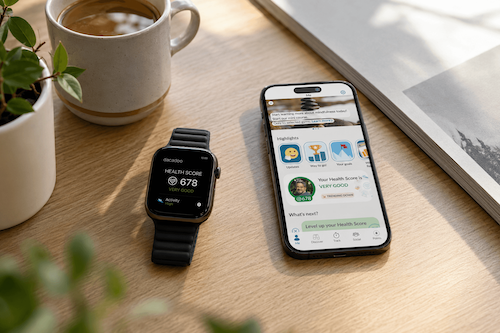
It was around then that Peter Ohnemus, founder and CEO of dacadoo, saw an opening. What if we could make health something you could measure, track and improve, not react to only when it failed? That spark became the dacadoo Health Score, a simple but radical idea to quantify wellbeing in a way that could motivate change. What began as an experiment has since grown into a global digital health ecosystem, empowering millions of users and some of the world’s largest insurers, retailers, and healthcare providers to make prevention both measurable and meaningful.
Now, as we move deeper into the third decade of the 21st century, digital health has gone from niche to noise. App stores overflow with promises of better sleep, sharper minds, calmer days. Some have made a difference. Many have disappeared into the scroll, undone by shallow engagement or technology that solved for itself rather than for the human at the other end. The difference, we’ve learned, rarely comes down to only code. Especially in a B2B2C go-to-market approach, it comes down to connection: the ability to build trust, relevance, and value. Here are the lessons learned along the way.
Lesson 1. Every Spark Needs Air.
For startups, funding is oxygen and in dacadoo’s early days, that air was thin. When Peter Ohnemus built the first version of the Health Score, investors struggled to imagine a world where prevention could be profitable. The digital health market barely existed, and few were willing to bet on a concept ahead of its time. Undeterred, Ohnemus self-financed the company’s first iteration, driven more by conviction than capital.
The first encounters with outside investors were equally trying. Twice, deals were nearly sealed. Twice, they vanished at the finish line, leaving Peter to continue financing the company by himself. When external funding finally arrived, it wasn’t through formal negotiations, but through a handshake deal with a believer who saw potential before the market did. Then came the turbulence: a global pandemic, geopolitical shocks, and rising interest rates that reshaped the rules of venture capital. Growth-at-all-costs gave way to survival and profitability. For dacadoo, that meant painful but necessary restructurings that turned the company profitable.
From that journey came a set of lessons: keep capital structures simple, complexity suffocates opportunity, avoid interest-bearing loans, as in young companies, debt grows faster than momentum, and know that dilution, while inevitable, should never define the mission. dacadoo survived because it learned to breathe through change, proof that in both digital health and prevention, longevity doesn’t come from speed. It comes from air — the space to pause, adapt, and move forward stronger..
Lesson 2. Base Marketing on Proof.
As digital transformation accelerated, marketing reinvented itself from print to pixels. For dacadoo, this shift mirrored the broader evolution of digital health: moving beyond awareness to building credibility in an ecosystem that rewards evidence over excitement. Legacy marketing channels were replaced by digital ecosystems built on credibility, where reputation determined visibility. For example, LinkedIn became the new marketplace of credibility, where B2B relationships were forged through conversation. Employees, clients, and industry experts became living proof of brand trust.
Technology added a new precision to the craft. Tools like HubSpot or Salesforce and advanced analytics made it possible to reach globally while engaging personally. Marketing became measurable, predictive, and iterative. Content stopped being collateral and became evidence: webinars that educated, whitepapers that demonstrated impact, videos that showcased results. Proof replaced promotion as the most persuasive form of communication.
However, with progress came responsibility: GDPR, HIPAA, and data-ethics standards defined the extent of personalisation. In digital health compliance became the foundation of credibility. Then came AI, amplifying reach, scoring leads, predicting engagement — but also reminding us that authenticity cannot be automated. In a world of endless noise, proof remains the most powerful marketing tool. And for dacadoo, the evidence is clear: a science-backed platform built on 400 million person-years of scientific data that delivers measurable results for clients and their customers worldwide.
Lesson 3. Selling Change Requires Credibility.
Selling prevention to industries built on managing risk is no small feat. At dacadoo we found ourselves negotiating not just solutions, but mind-shifts: convincing conservative players that prevention could be profitable, even when their entire model depended on avoiding uncertainty. Sector after sector taught us that innovation in such environments demands extraordinary patience and credibility.
Sales cycles stretched into marathons, with pilot projects often languishing without scaling. Tackling global deals added another layer of complexity: what worked in Zurich didn’t always translate to Tokyo or Toronto. Regulations, languages, and cultural norms acted as silent deal-killers unless addressed from the first conversation. And even when the deployment succeeded, the perennial “buy-vs-build” debate threatened. Many insurers preferred to build their own wellness solutions, rather than partner with established experts. The paradox floated above us: everyone wanted prevention, but very few were willing to rely on a dedicated health-tech partner to deliver it.
Over time, we shifted our approach. We stopped chasing volume and began building depth: choosing partners ready to act, demonstrating measurable value, and building repeatable success stories. Strategic partnerships became our multiplier, not just a channel. A growing body of evidence shows that insurers who embrace digital health platforms and real-world outcomes are far more likely to succeed. Growth, especially in a market driven by caution, came not from speed, but from strategy: patient, persistent, and grounded in results.
Lesson 4. Engagement Isn’t a Feature, It’s the Mission.
In health-tech, building a product is easy. Building one people use, and keep using, is another matter entirely. Over the years, dacadoo learned that engagement isn’t a metric: it’s the mission. Every feature, every interface, every notification carried the same question: does this help someone live better?
Early on, dacadoo made a deliberate choice that would define its architecture: one API, one unified data model, one language for health. The vision was clear: to stay device and platform-agnostic in a world of fragmented devices and shifting standards. That decision proved pivotal. While the market cycled through new wearables and protocols, dacadoo’s open ecosystem continued to grow, seamlessly integrating fresh data sources and third-party services. Today, that strategy shows its value, as roughly half of all active users now log their activity directly in the app.
Accessibility became a design philosophy: building so more people could use the product made it better for all of them. The same lesson applied to scale: in digital health, custom integrations might impress in a pilot, but consistency wins over time. Templates, guardrails and dynamic modules let you grow without losing identity. And beneath all of that sat the deepest insight, which came not from tech but from psychology. When users had friends on the platform, they tended to stay longer. It showed that health can be social, but that social is just one of several engines of engagement. Rewards, social features and gamification became modular building blocks, letting each client choose the mix that makes their solution win.
Lesson 5. Scalability Starts with Stability.
In its early days, dacadoo’s engineering team lived in the familiar chaos of every ambitious startup: late-night releases and manual fixes. The product was evolving fast, but so were the problems. Innovation moved faster than infrastructure, and stability was often the price of progress.
The decision to move everything to the cloud was the turning point. Automation replaced firefighting, and Infrastructure-as-Code brought consistency to what had once felt like improvisation. Suddenly, updates became routine instead of nerve-wracking. That foundation changed everything. Testing became part of the process, not the postscript. Security stopped being the department of “no” and became a quiet partner in trust built on multi-layered systems that protect without slowing progress. The platform that once required courage to deploy now runs weekly releases without a ripple.
Today, AI and automation assist across development, predicting bugs, writing documentation, and learning from every build. But the real story isn’t about speed or sophistication. In healthtech, reliability is innovation.
What’s next: Health 5.0 and dacadoo 5.0.
Healthcare is entering a new chapter. Where Health 4.0 focused on digitalising care, Health 5.0 is about reimagining health as a lifelong partnership, a model built around individuals, not just patients. Driven by AI, IoT, blockchain and real-time data flows, this model envisions a system where people own their health information, make empowered decisions, and access prevention services seamlessly, no matter where they are. In this new era of health, treatment becomes the exception and wellbeing the rule.
Into this future steps dacadoo with its Generation 5 Digital Health Engagement Platform (DHEP). With its launch in May 2025, the platform is explicitly built for this next era: simpler, smarter, more inclusive, and personalised. By combining a multitude of engagement features, intuitive social networking,
hyper-personalized AI coaching based on real-time data, behavioural insight, as well as real-time monitoring, the platform becomes a real-time guide for users, helping them take health prevention into their own hands.
The payoff now extends far beyond traditional insurer and employer programs: banks, retailers, and health providers using digital health engagement tools are already seeing measurable gains in outcomes and cost efficiency. For instance, the implementation of dacadoo’s Digital Health Engagement Platform (DHEP) shows a 37% jump in page views, a 5% cut in overall health-care related costs (as confirmed by a study conducted by the University of Groningen), and up to 50% higher order value for retail partners.
In short: prevention will define the next decade of health. In the world of Health 5.0, the winners will be those organisations that can deliver dependable, personalised engagement, the kind that empowers people to take ownership of their wellbeing long before diseases materialise. dacadoo enters this new age with the conviction that digital health must move beyond quantify behaviour, it must help produce better outcomes at scale. Meaningful progress will emerge from the daily decisions people make, supported by technology built to help those decisions last.