


DHEP-API

APIを介して、お客様独自のデジタルヘルスアプリを構築する、もしくは既存のエコシステムに機能を追加することができます。

DHEPホワイトラベル (DHEP-WL)

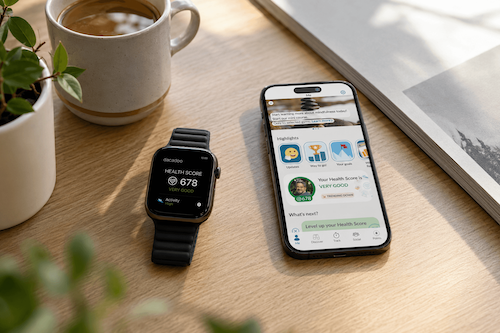
dacadoo プラットフォームを利用して、お客様専用のヘルス・ウェルビーイングアプリを提供できます。

dacadoo SaaS 

dacadooが提供するテナントを利用してヘルスアプリにアクセスすれば、エンドユーザーはすぐにdacadooの機能を利用できます。 

ヘルススコア 

APIを介して、dacadoo のヘルススコア機能をお客様のデジタルヘルス エンゲージメント プラットフォームの一部として統合する、もしくはスタンドアロン機能として利用できます。  

すべてのDHEPソリューションを確認

新規顧客獲得

プロアクティブなデジタルヘルスプロモーションのリーダーになり、新規顧客をビジネスに引き寄せましょう。 

顧客関係の維持

既存顧客や自社従業員の健康とウェルビーイングをサポートすることで、長期的な関係性やロイヤリティを構築することで、顧客喪失や従業員の離職を軽減しましょう。

エンゲージメントの強化

パーソナライズされたデータドリブンのインサイト、健康に関するアドバイス、インセンティブを利用して、ユーザーエンゲージメントを高め、クロスセルやアップセルの機会を増やしましょう。 

dacadoo をどう活用できるか詳細を確認する。

保険会社

リスクを軽減し、売上を増やし、顧客離れを減らすために、被保険者の健康的なライフスタイルを促進します。

医療提供者

顧客がより健康的なライフスタイルを選択し、全体的な人生の幸福度を向上できるようにサポートすることで、エンゲージメントを高め、長期的な関係構築を目指します。

小売業者 

データドリブンなインサイトやエンゲージメント機能を駆使し、顧客に合わせたパーソナライズされたコンテンツを提供することで、販売促進に繋げます。

雇用主

従業員がより健康的なライフスタイルを実現できるようサポートし、その結果として生産性の向上や欠勤、病欠の減少などを生み出す、素晴らしい福祉文化を促進します。

銀行 

生命保険や健康保険を既存の顧客にクロスセルしたり、ライフスタイル データを使用して顧客の獲得とエンゲージメントを促進するパーソナライズされたオファーを作成したりできます。

dacadoo をどう活用できるか詳細を確認する。

マネジメントチーム

ヘルスケアエンゲージメントの領域を変革している経験豊富で情熱的なイノベーターたちです。

科学諮問委員会 

著名なヘルスケアおよびデータの専門家で構成される科学諮問委員会は、dacadooのヘルスエンゲージメントテクノロジーの科学的厳密性と有効性を確保しています。

dacadooチーム

日々の運営を支えるdacadooメンバーをご紹介します。dacadooのダイナミックで協力的なチームは組織の要です。

ホワイトペーパーとレポート

最新かつ詳細な業界研究動向と分析を入手してください。

インフォグラフィック

健康データを視覚化することで、dacadooが世界中のビジネスをどのようにサポートしているかが理解できます。

ウェビナー 

業界エキスパートによる、インサイトやガイダンスの最新のビデオを視聴できます。

パンフレット

ヘルスエンゲージメン
トおよびヘルスリスク定量化のソリ
ューション一連のプロダクト詳細については、パンフレットをダウ
ンロードしてください。 

導入事例

dacadooのテクノロジーによってお客様がどのように変革したか、
その素晴らしい事例を確認してください。

Food as Medicine: How retailers can elevate their role in customer health and trust 

4分で読めます

It wasn’t that long ago that health-conscious shopping was a niche pursuit that ran second place to the simple satisfaction of eating. In the past few decades, however, that’s all changed. More than just a fleeting trend, health-conscious shopping is a cultural phenomenon that’s reshaped consumer expectations—and the entire retail landscape along with it. With food now commonly recognized for its impact on well-being—and, indeed, as a form of medicine—retailers are at the frontline of daily grocery health decisions. In this article, we’ll examine why the “Food as Medicine” perspective is so important for modern retailers, and how platforms like dacadoo can help improve customer loyalty, brand differentiation, and long-term growth.
Food as medicine

Key takeaways 

  • Despite inflation, consumers consistently prioritize and are willing to pay for wellness. This makes “food as medicine” a durable retail strategy, not a temporary trend. 
  • In a market where many consumers are often confused about nutrition, retailers can build deep brand loyalty by offering clarity and personalized guidance. This positions them as trusted partners, differentiating them from competitors. 
  • Using existing customer data to understand nutritional habits allows retailers to create a measurable and scalable wellness strategy. This provides valuable insights for both targeted customer engagement and strategic business decisions. 
  • The “food as medicine” approach opens up opportunities for retailers to collaborate with a broader health ecosystem, including insurers and health brands. These new B2B partnerships create additional revenue streams and increase customer value. 
  • Digital tools like dacadoo can transform this strategy from a concept into a real-world, highly personalized experience for customers.  

Why retailers need to embrace Food as Medicine 

Although the idea that food influences health is hardly new, its prominence in consumer thinking has surged dramatically. Despite global economic uncertainties and inflationary pressures, consumer expenditure on health and wellness is not only solid but, for many, is increasing. A recent Accenture report revealed that approximately 80% of consumers plan to sustain or grow their wellness spending

Research from Deloitte further solidifies this. Deloitte found that 84% of shoppers prioritize health in their fresh food purchases—and, perhaps more significantly, 55% are willing to pay a premium for healthier options. Data like this clearly shows that health is no longer a “nice-to-have” add-on for consumers, but a fundamental factor in the shopping equation.  

For retailers, this has major implications when it comes to remaining resilient during economic downturns. With consumers continuing to prioritize their health, irrespective of the economic climate, catering to the health and wellness market is effectively a recession-proof strategy.  

The loyalty and differentiation opportunity 

Of equal importance to future-proofing is brand differentiation. With fresh and healthy food categories among the fastest-growing in the retail sector, a health-oriented retail strategy helps capture and retain customers in a highly crowded marketplace.   

That said, simply stocking healthy items isn’t enough. Deloitte’s research also reveals a major knowledge gap, with many consumers confused about what truly constitutes healthy eating. This confusion offers a major opportunity for retailers, however.  

Stepping in to offer clear guidance, reliable information, and a curated selection that simplifies healthy choices, retailers can turn themselves into trusted health partners rather than just product outlets. This builds a major level of brand differentiation that transcends mere transactional relationships. When a retailer helps a customer understand the complexities of healthy eating, they create consumer trust and loyalty that are far more enduring than any discount program could ever hope to be. 

How retailers can act on Food as Medicine

Retail wellness strategy

Turning the “Food as Medicine” philosophy into a tangible retail strategy involves a number of key factors: 

Clearer nutrition labeling and guidance: Beyond standard nutritional panels, retailers can implement in-store and app-based systems that use simplified, visual cues to highlight key health benefits. This could include color-coded ratings, “heart-healthy” or “high-fiber” badges, or even QR codes linking to deeper nutritional insights. 

Personalized nudges and digital engagement: Using loyalty program data, retailers can provide tailored recommendations through receipts, dedicated loyalty apps, and email campaigns. For example, retailers can offer a weekly summary that highlights healthy swaps based on past purchases or offer recipe ideas featuring nutrient-dense ingredients the customer tends to buy. 

Gamification and community initiatives: Engaging customers through “healthy basket challenges” or family-focused nutrition education programs can make healthy eating more fun and accessible. Retailers can host in-store cooking demonstrations focusing on healthful meals or partner with local dieticians for educational workshops. 

Cross-industry partnerships: The healthy eating movement naturally lends itself to collaborations beyond traditional retail. Partnering with health insurers to offer incentives for healthy food purchases, integrating with health and fitness apps for holistic wellness tracking, or even co-creating content with healthcare providers can extend a retailer’s reach and value proposition.  

The business case for building customer trust and long-term value 

While Food as Medicine may be a noble pursuit when it comes to corporate social responsibility, it’s a strategy that also makes money. Retailers that position themselves as trusted guides on the health shopping journey gain several financial advantages.  

Improved customer retention and lifetime value: Customers who feel supported in their health journey are more likely to remain loyal, increasing their long-term value to the retailer. This moves the relationship beyond price-sensitivity to value-driven engagement. 

Differentiation beyond price wars: In a market often driven by the lowest price, a health-centric approach allows retailers to compete on value, trust, and well-being, rather than solely on cost. 

New B2B and ecosystem opportunities: The wellness market (estimated by McKinsey to be a $2 trillion industry) offers immense potential for new partnerships. Collaborating with health insurers, digital health platforms, and wellness brands creates synergistic relationships, expanding revenue streams and solidifying the retailer’s position within a broader health ecosystem.  

Gain healthier customers and earnings reports with dacadoo  

Consumer trust in retailers

To effectively implement measurable and scalable “Food as Medicine” strategies, retailers need to engage with digital solutions. At dacadoo, we offer a suite of tools that allow retailers to establish their position as trusted partners in their consumers’ health quickly and effectively. 

At the core of our offerings is our Digital Health Engagement Platform (DHEP)—a holistic platform that combines lifestyle coaching, behavioral science, and gamification to drive healthier habits. Working hand-in-hand with this is our Grocery Basket Score (GBS™), a science-based system that analyzes a customer’s monthly purchases to provide a simple, actionable score of their basket’s nutritional quality. With these platforms delivering highly personalized nutrition guidance—and integrating easily into a retailer’s existing loyalty programs—they offer a way forward that’s as healthy for retailers as it is for their customers.  

To find out more about how dacadoo’s GBS™ and Digital Health Engagement Platform (DHEP) can help your retail business thrive, you can contact us here.     

マーケティング・マネージャー

コンテンツ

注目記事

4分で読めます

- 5分で読めます

- 5分で読めます

- 5分で読めます

•   7 minutes read

- 5分で読めます

関連記事

4分で読めます

While most people are aware that excess weight is a major financial burden on the healthcare system, people tend not to appreciate the scale of the problem. Research from the McKinsey Health Institute (MHI) projects a $2.67 trillion loss in GDP by 2050, due to the impact obesity has on labor force participation and productivity. Within the wider economy, the rising tide of chronic conditions linked to high Body Mass Index (BMI) is a serious economic challenge for insurers, healthcare providers, and self-insured employers that’s driving up healthcare spending and eroding profitability. Fortunately, a growing body of evidence (perhaps a poor choice of expression) confirms that even modest weight loss is directly associated with a significant, measurable cost reduction in healthcare. The question is no longer ‘if’ weight loss saves money, but how to achieve it—and more importantly, how to sustain it as a behavioral change at scale. In this article, we’ll explore the relationship between BMI and healthcare costs, and how dacadoo’s Digital Health Engagement Platform (DHEP) bridges the gap between clinical evidence and measurable financial action.

4分で読めます

In Part 1 of our series, we explored how the Grocery Basket Score (GBS™) deepens customer engagement and builds loyalty by providing clear, personalized nutrition guidance. GBS™ is a science-based score that evaluates the overall nutritional quality of a customer’s shopping basket over time. In this second part, we’ll see how GBS™ is much more than just a customer engagement tool—it’s a powerful engine for direct commercial growth that drives tangible increases in revenue.

- 6分で読めます

ヘルスケア業界は進化しており、患者の関与を従来のモデルを超えて推進しています。患者は現在、積極的な参加、利便性、そしてパーソナライズを求めています。デジタルツールとデータを活用し、共感をもって接することで、持続的な関与が促進されます。これらの洞察がどのようにして、より積極的でパーソナライズされた体験を創出するかを発見してください。

- 5分で読めます

今日の急速に変化する小売環境では、新しい顧客を獲得することが競争力を維持するために重要です。しかし、獲得にのみ焦点を当てることでは不十分で、効率性が鍵となります。このブログでは、成長と収益性のバランスをとる7つの顧客獲得戦略を紹介します。

デモの
お問合せ

dacadooがもたらす可能性を探求してみませんか?

デモをご希望の方は、お問い合わせフォームよりご連絡ください。お客様のニーズに合うソリューションをご提案します。


最新の投稿

最新のヘルスとウェルビーイングに関するニュースやインサイトを調べましょう。

4分で読めます

While most people are aware that excess weight is a major financial burden on the healthcare system, people tend not to appreciate the scale of…

- 5分で読めます

医療保険および生命保険業界で運用コストが上昇する中、保険会社は競争力を維持するために、より賢明な戦略を採用する必要があります。本記事では、そのための7つの方法を紹介します。

- 5分で読めます

Faced with rising costs, growing mental health needs, workforce shortages, and a widening gap between our lifespan and health span, current healthcare models are struggling, to say the least. While there’s no doubt that changes are needed in healthcare, the question is what form these changes will take. Emerging as a solution frontrunner is digital health engagement. The sustained use of technology to manage health and wellness is a data-backed strategy that shifts the center of gravity from reactive, expensive care to proactive, cost-saving prevention. In this article, we’ll examine the considerable advantages that digital health engagement brings to the healthcare equation, and how platforms like dacadoo’s Digital Health Engagement Platform (DHEP) may be the answer that insurers and healthcare providers are looking for.

- 5分で読めます

Digital banking has made services faster and more accessible, but it has also reduced personal connections. With branch visits nearly gone, customer engagement in banking is harder to sustain—yet it’s engagement that builds trust and drives loyalty. A new engagement model is needed, one that connects financial well-being with health & wellness. Guided by the principle that health is wealth, banks can adopt digital wellness strategies to strengthen relationships and deliver long-term value. This article explores how applying wellness principles through a Digital Health Engagement Platform (DHEP) offers banks a modern way to drive loyalty and stay competitive.

•   7 minutes read

保険業界がデータ主導型モデルへと移行する中で、テクノロジーはリスク評価と顧客エンゲージメントの在り方を大きく変えつつあります。AI、予測分析、ウェルネスアプリから得られるデータを活用することで、保険会社は引受業務の最適化、保険金支払いコストの削減、そして個別化された保険商品の提供が可能になります。 この変革は、業務効率の向上と顧客体験の改善を同時に実現し、より積極的かつコスト効率の高い保険業界への道を切り拓いています 。

- 5分で読めます

医療業界はデータの収益化を通じてコスト削減を実現しています。dacadooの健康・ウェルネストラッキングアプリを活用することで、医療機関はリアルタイムのインサイトを得て、コストの最適化、業務効率の向上、意思決定の強化を実現できます。健康データを実用的なコスト削減施策へと変換することで、より賢明なリソース配分と優れた患者ケアを可能にします。このアプローチが医療経済をどのように変革するのかをご紹介します。

How Digital Health Engagement Reduces Costs and Strengthens Healthcare Systems

- 5分で読めます

Faced with rising costs, growing mental health needs, workforce shortages, and a widening gap between our lifespan and health span, current healthcare models are struggling, to say the least. While…
Faced with rising costs, growing mental health needs, workforce shortages, and a widening gap between…

Customer Engagement in Banking – How digital wellness principles inspire loyalty

- 5分で読めます

Digital banking has made services faster and more accessible, but it has also reduced personal connections. With branch visits nearly gone, customer engagement in banking is harder to sustain—yet it’s…
Digital banking has made services faster and more accessible, but it has also reduced personal…

The Business of Healthy Habits – Part 2 in our series on how the Grocery Basket Score (GBS™) benefits retailers

4分で読めます

In Part 1 of our series, we explored how the Grocery Basket Score (GBS™) deepens customer engagement and builds loyalty by providing clear, personalized nutrition guidance. GBS™ is a science-based…
In Part 1 of our series, we explored how the Grocery Basket Score (GBS™) deepens…

データ主導の保険戦略と導入事例 

•   7 minutes read

As insurance shifts toward a data-driven model, technology is redefining risk assessment and customer engagement. By leveraging AI, predictive analytics, and wellness app data, insurers can optimize underwriting, reduce claims…
As insurance shifts toward a data-driven model, technology is redefining risk assessment and customer engagement….

ヘルスケアにおけるデータ収益化 

- 5分で読めます

The healthcare industry is unlocking savings through data monetization. With dacadoo’s health wellness tracking app, organisations can harness real-time insights to optimise costs, improve efficiency, and enhance decision-making. Turning health…
The healthcare industry is unlocking savings through data monetization. With dacadoo’s health wellness tracking app,…

医療における患者エンゲージメントを向上させるには

- 6分で読めます

The healthcare landscape is evolving, pushing patient engagement beyond traditional models. Patients now demand active participation, convenience, and personalization. Leveraging digital tools and data, with empathy, fosters lasting engagement. Discover…
The healthcare landscape is evolving, pushing patient engagement beyond traditional models. Patients now demand active…